Prices and budget
Bathroom renovation cost: what budget should you plan in 2026?
For a 5 to 6 m² bathroom, allow on average €4,500 to €9,000 for a standard full renovation, supply and installation included, €2,000 to €4,500 for a refresh and from €10,000 for a high-end project. These are indicative averages: only a quote drawn up after a site visit is binding.
These amounts are averages seen in France in 2026 in the main renovation price guides. The overall budgets include VAT, supply and installation, across all trades: strip-out, plumbing, electrics, tiling and sanitaryware. They are not our price list, but a benchmark to put a quote in context. As a reminder, renovating a home completed more than two years ago is invoiced with VAT at 10%, new builds at 20%.
More than the floor area, three decisions shape the budget: keeping or changing the layout of the fittings, replacing the bath with a level-access shower or not, and the range of the tiles and sanitaryware.
Budget by level of renovation
| Level | Average budget | What this level usually covers |
|---|---|---|
| Small budget (refresh) | €2,000 to €4,500 | Layout kept: some fittings replaced, partial retiling of the floor or walls |
| Standard full renovation | €4,500 to €9,000 | Strip-out, plumbing changes, new floor and wall tiles, mid-range sanitaryware |
| High end | from €10,000, up to about €15,000 | Walk-in shower, large formats, premium fittings and taps |
| Full renovation, per m² | €1,000 to €2,000 per m² | All items included, supply and installation |
Small rooms cost more per square metre: plumbing, electrics and fittings are almost fixed costs, whether the floor measures 4 or 7 m². A 3 m² shower room therefore does not cost half as much as a 6 m² bathroom, and a price per m² should always be read alongside the size of the room.
The tiling items in a bathroom budget
In a full renovation, tiling takes up several lines of the quote. Here are the average ranges seen for each, mostly for labour only:
| Item | Average range | Details |
|---|---|---|
| Removing old floor tiles | €15 to €30 per m² | Labour |
| Removing old wall tiles | €30 to €50 per m² | Labour |
| Removal with rubble disposal | €40 to €50 per m² incl. VAT | Labour and disposal included |
| Floor levelling compound | €15 to €35 per m² | Supplied and applied |
| Laying ceramic wall tiles | €30 to €60 per m² | Labour, tiles not included |
| Laying floor tiles, standard size | €30 to €60 per m² | Labour, tiles not included |
| Laying large formats | €50 to €90 per m² | Labour, back-buttering, levelling not included |
| Mosaic (shower floor, niche) | €50 to €100 per m² | Labour, mosaic on mesh sheets |
| Complete tiled walk-in shower | €2,500 to €6,000 | Base, waterproofing, plumbing, tiling, glass screen and taps |
In a bathroom, laying often costs more per m² than in an open room, because of the cuts around fittings, boxing and water supplies. As an order of magnitude, a standard bathroom has about 5 m² of floor and 15 to 18 m² of wall tiles, which means 3 to 5 days of tiling depending on the products and conditions. The detail by tile size is in our guide to tiling costs per m².
Walk-in shower and waterproofing
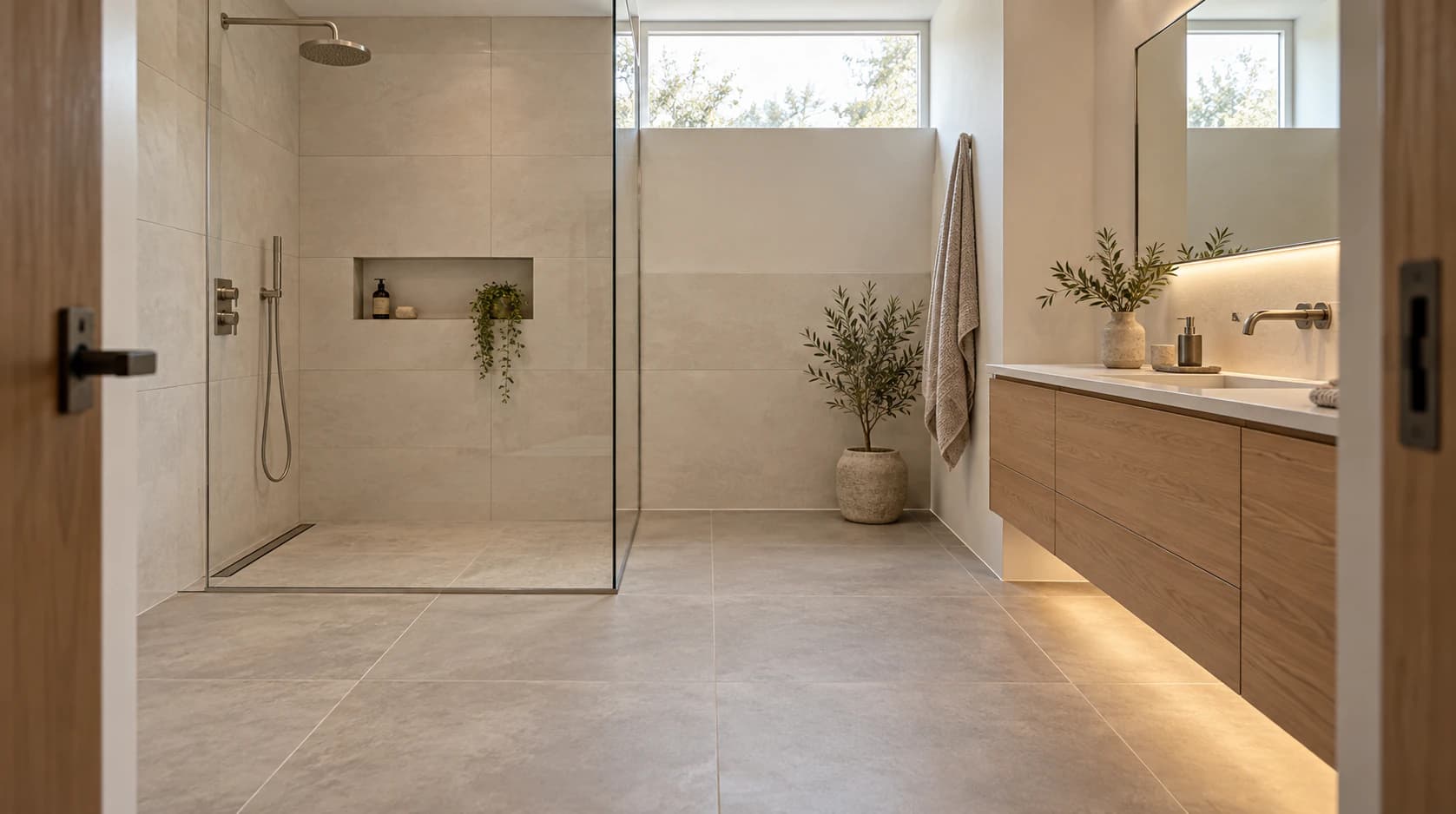
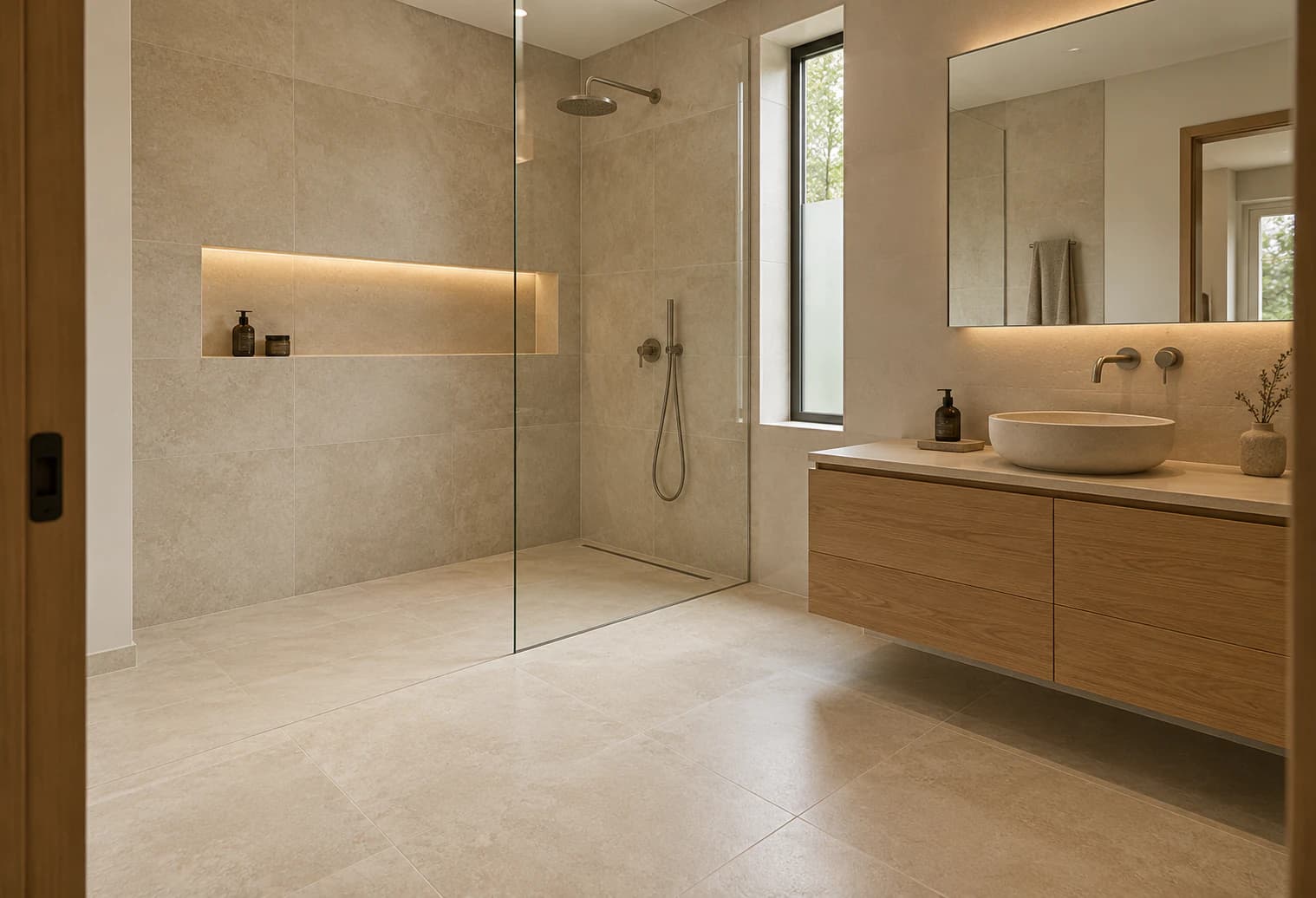
Replacing a bath with a level-access shower is often the heaviest item. A complete tiled walk-in shower costs on average €2,500 to €6,000: the base (a tile-ready shower tray or a sloped mortar bed), waterproofing, plumbing changes, tiling, glass screen and taps. Labour alone, across all trades, comes to €1,000 to €2,500. Moving the drain, lowering the slab or choosing premium fittings can take the total to €7,000 and more: our guide to walk-in shower costs explains these gaps.
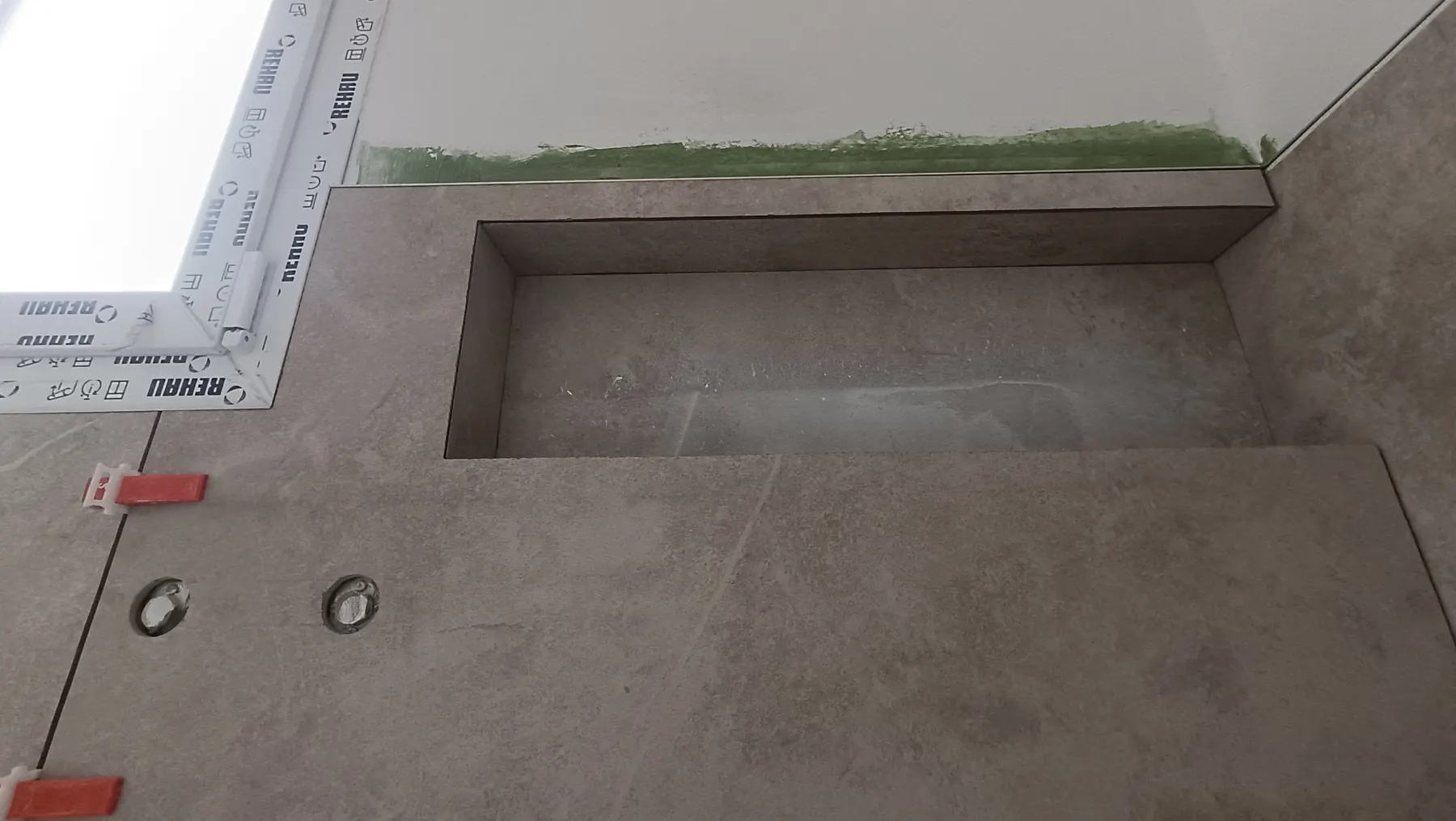
Neither tiles nor grout are waterproof: what protects the room is the waterproofing system under the tiles, applied in the shower and around the bath with corner tapes and a careful seal at the drain. It is usually included in the price of the shower. When it appears as a separate line, check that it covers the whole shower area and the upstands at the foot of the walls. Our article on waterproofing under tiles explains the method.
Plumbing included: a renovation led by the tiler
A bathroom is rarely renovated without touching the pipework. When we carry out a full renovation, we also handle the plumbing changes the new layout requires:
- moving or adding a waste, with the fall it needs;
- new water supplies for a shower or a vanity unit;
- fitting the frame of a wall-hung toilet and closing in its boxing;
- removing, refitting and connecting the sanitaryware.
You deal with a single contact: the pipework, the shower fall, the waterproofing and the tiles are planned together, and the pipes are checked before the walls are closed in. These changes depend too much on distances and substrates to be summed up by an average: they are priced line by line after the visit. Electrics (lighting, sockets, towel rail) are handled by an electrician and are part of the overall budgets above. Our bathroom renovation and tiling page sets out how we work, from strip-out to finishing.
What changes the budget
For the same floor area, the gap between two bathrooms mostly comes down to these choices:
- the layout: keeping the shower, basin and toilet where they are limits the plumbing, whereas moving them calls for new wastes;
- a level-access shower: depending on the height available and the type of floor, the floor sometimes has to be raised or the slab cut into;
- the tiled area: full-height wall tiles or tiles limited to the splash zones make a clear difference to the cost of bathroom wall tiling;
- the condition of walls and floor: walls to line with moisture-resistant plasterboard, a floor to level, old tiles to remove or cover;
- the tiles chosen: large formats, mosaic or natural stone take longer to lay;
- the range of fittings: sanitaryware, taps, screen and vanity unit weigh mainly on the supply share;
- access: an upper floor with no lift, parking and rubble disposal lengthen the job, with no standard surcharge.
Paris, Île-de-France and Évreux: how big is the gap?
Labour costs on average 20 to 30% more in Paris and Île-de-France than in the provinces, where Évreux and the Eure sit. The gap applies to labour: on a budget that also includes the supply of tiles and sanitaryware, it therefore weighs less than those 20 to 30%.
In Paris, building constraints count too: booking the lift, protecting common areas, working hours set by the building’s rules, carrying rubble down and parking. In an apartment, where the slab generally cannot be cut into without approval, a level-access shower is built within the existing screed or by slightly raising the floor, which needs planning from the quote stage. We work from Évreux throughout the Eure, in Paris and across Île-de-France: a few of our completed bathrooms give an idea of the finish.
Reading a bathroom quote
A clear bathroom quote separates supply and installation, item by item, with quantities. Prepare your request with our article on what to prepare for a quote, then check that the quote states:
- the strip-out (bath, wall tiles, floor, sanitaryware) and rubble disposal;
- the plumbing changes: wastes, water supplies, toilet frame;
- substrate preparation: moisture-resistant boards, levelling, primer;
- the waterproofing under the tiles and the areas treated;
- the floor and wall tiling: areas, tile size, laying pattern, tiled height;
- the grout, the flexible sanitary sealant, the trims and the access panel;
- the sanitaryware, taps and screen, stating whether they are supplied or not.
Often left out of the tiler’s quote: the tiles and sanitaryware if you buy them yourself, electrics, ventilation, painting the ceiling and untiled walls, and storage furniture. A quote drawn up after a visit that lists these exclusions clearly is the only one that is binding, and the only one that lets you compare.
Frequently asked questions
Why does a small shower room cost more per square metre?
Because part of the budget hardly depends on the floor area: removing the fittings, the plumbing connections, the electrics and the taps cost about as much in 3 m² as in 6 m². Spread over a small area, these items push up the price per square metre. That is why the average of €1,000 to €2,000 per m² for a full renovation should always be read with the size of the room in mind.
Do all the wall tiles need redoing if only the bath is replaced?
Often, yes. Taking out a bath damages the surrounding tiles and reveals a section of wall that was never tiled below the rim. Finding the same tile years later is rare, and a partial repair shows. If the existing tiles are sound and still available, a local repair remains possible: we assess it during the visit, checking the substrate behind the tiles as well.
Does tiling only the wet areas reduce the budget?
Yes, the tiled area and the laying time both go down. The shower, the bath surround and the wall behind the basin stay tiled and waterproofed, while the other walls receive a paint suited to wet rooms. The result looks lighter, provided the junction between tiles and paint is neat, with a trim or a clean edge at a consistent height.
Should the quote separate supply and installation?
It is better. A quote that shows supply and labour separately for each item lets you compare proposals, see what your choice of tiles and sanitaryware costs, and change a model without having everything repriced. It should also state the quantities, the tile size, the areas covered by waterproofing and what remains your responsibility, such as electrics or painting.
Does keeping the water supplies where they are really lower the price?
Yes, it is one of the most effective levers. Keeping the shower, basin and toilet in place avoids creating new wastes, which need a sufficient fall and sometimes a raised floor or boxing. The tiling itself is redone in the same way. A new layout is worth it when it genuinely improves how the room works, for example to gain a level-access shower.