Prices and budget
Tiling cost per square metre: average prices in 2026
In 2026, laying floor tiles in France costs on average €30 to €60 per m² in labour for a standard size and €50 to €90 per m² for large formats, tiles not included. The real price depends on the substrate, the tile size and the laying pattern: only a quote drawn up after a site visit is binding.
The figures below are indicative averages seen in France in 2026 in the main renovation price guides. Unless stated otherwise, they cover labour only: adhesive, grout and spacers included, but not the tiles, the skirting or any substrate preparation. They are not our price list, but a benchmark to put a quote in context and plan your budget.
The gap between the bottom and the top of a range almost always comes down to three questions: is the substrate ready to be tiled, what size are the tiles, and how will they be laid?
How much does tiling cost per m²?
These ranges apply to adhesive-fixed tiling on a sound substrate in a home, over typical areas: a very small room or a complicated job falls outside them.
| Work | Average range | What the range covers |
|---|---|---|
| Floor tiles, standard size (30 × 30 to 60 × 60 cm) | €30 to €60 per m² | Labour, straight adhesive-fixed laying on a sound, flat substrate, adhesive and grout included |
| Large formats (60 × 120, 120 × 120 cm and larger) | €50 to €90 per m² | Labour, back-buttering and two installers, levelling compound not included |
| Ceramic wall tiles (faïence) | €30 to €60 per m² | Labour, adhesive-fixed on a sound wall |
| Wood-effect planks, straight or offset | €35 to €55 per m² | Labour, long planks on a very flat substrate |
| Wood-effect planks, herringbone or chevron | €45 to €65 per m² | Labour, tiles not included |
| Mosaic on mesh sheets | €50 to €100 per m² | Labour, adhesive-fixed; artistic work can exceed €100 per m² |
| Outdoor tiles, bonded or mortar-bedded on an existing slab | €30 to €60 per m² | Labour; building the slab and waterproofing not included |
| Terrace pavers on pedestals | €70 to €150 per m² | Supply and installation |
| Marble and natural stone | €40 to €80 per m² | Labour, calibrated tiles, adhesive-fixed; stone and polishing not included |
| Removing old floor tiles | €15 to €30 per m² | Labour, rubble disposal often extra |
| Removing old wall tiles | €30 to €50 per m² | Labour, rubble disposal often extra |
| Floor levelling compound | €15 to €35 per m² | Supplied and applied, around 3 to 5 mm; €10 to €20 per m² for labour only |
These ranges do not always say whether VAT is included. As a reminder, renovation work in homes completed more than two years ago is invoiced with VAT at 10%, new builds at 20%.
Large formats, wall tiles, wood effect: why prices differ
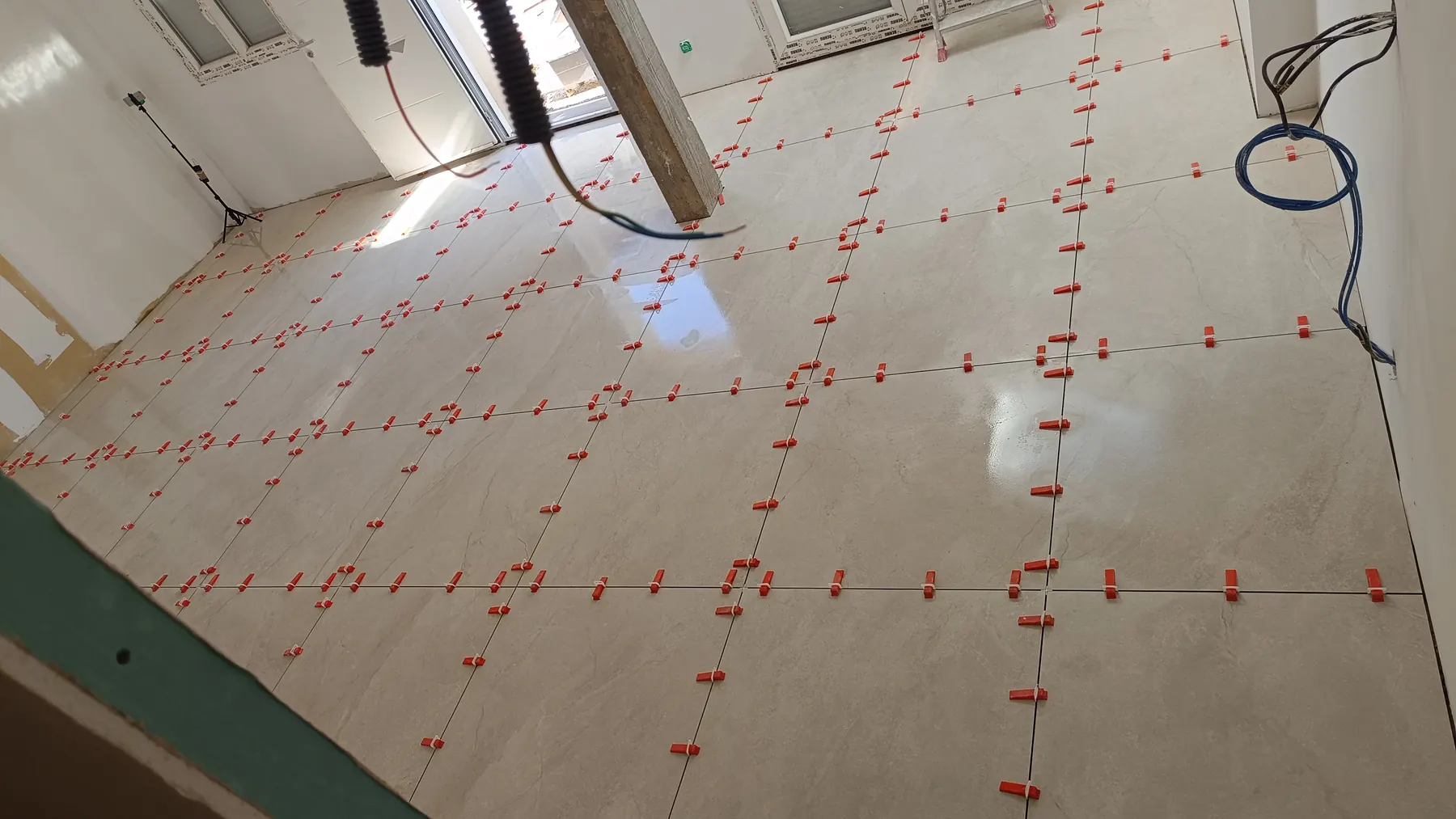
A 60 × 60 cm tile is priced like a standard size. At 60 × 120 or 120 × 120 cm, the job changes in nature: each tile is buttered on the back as well as on the substrate, handled by two people with suction lifters, and the floor must be perfectly flat, which often calls for a levelling compound. Hence large-format tiling at €50 to €90 per m².
Wall tiles fall within a similar range to floors, but a wall progresses more slowly: roughly 5 to 8 m² a day, against 8 to 12 m² for a floor laid straight, because of the cuts around sockets, windows and water supplies.
Wood-effect tiles come as long planks that do not tolerate an uneven substrate: allow €35 to €55 per m² for straight or offset laying, and €45 to €65 per m² for herringbone or chevron, which take longer to set out and cut. Our guide to laying wood-effect tiles covers these patterns in detail.
What changes the price per m²
For the same area, two quotes can differ widely. These are the factors that weigh most on a tiler’s rate per m²:
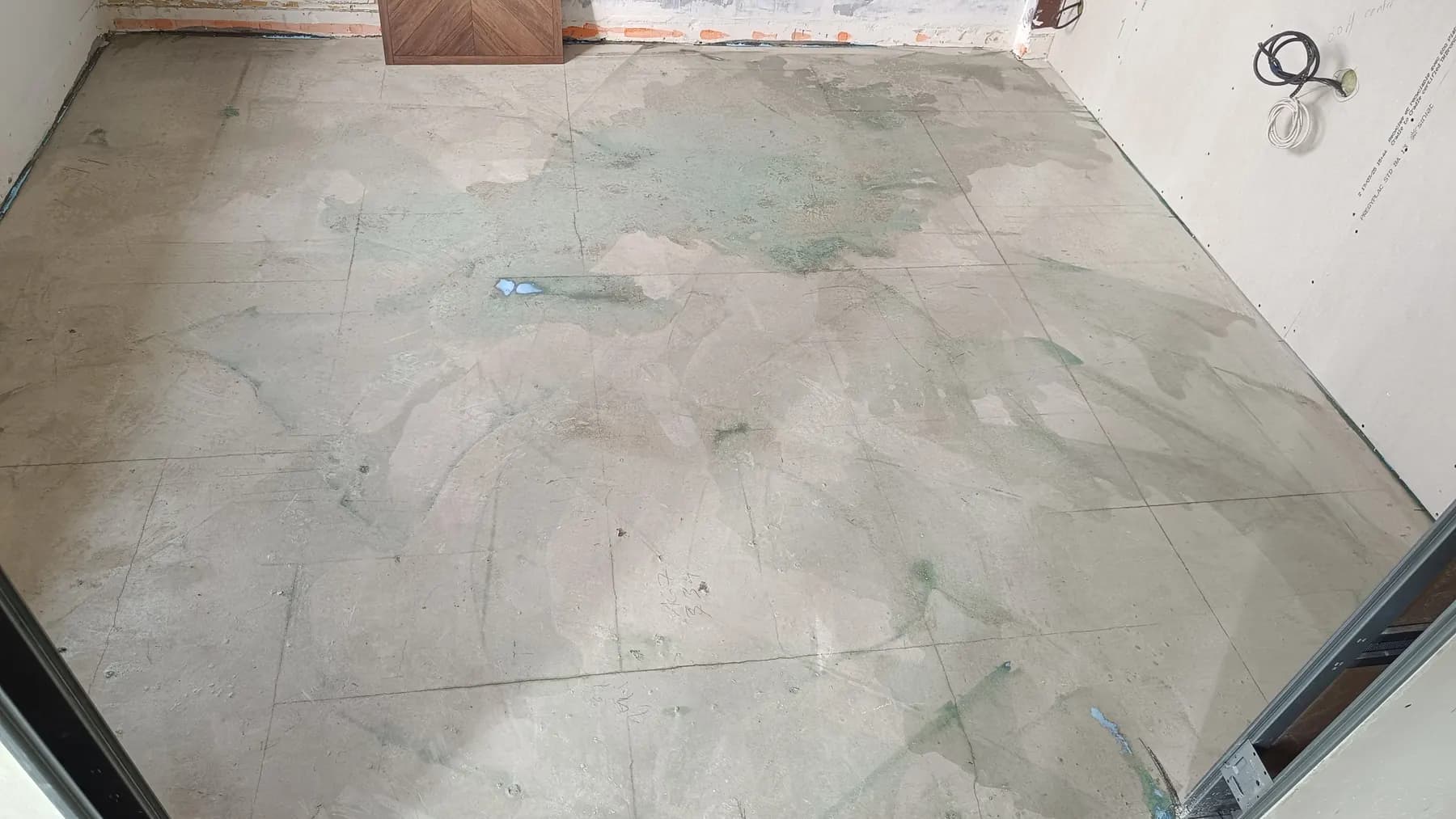
- the substrate: a flat, sound floor can be tiled straight away, whereas a cracked slab, an old covering or a timber floor needs preparation, priced separately;
- the laying pattern and the tile layout plan: as a guide, €30 to €45 per m² for straight laying, €35 to €55 per m² offset and €40 to €60 per m² on the diagonal, which multiplies the cuts;
- the tile size: small tiles, hexagons and very large formats take longer;
- the room: in a bathroom, laying often costs more per m² because of the cuts around fittings (see our guide to bathroom renovation costs);
- underfloor heating: a deformable adhesive, movement joints and sometimes an uncoupling membrane are added to the laying cost;
- the grout: an epoxy grout, more stain resistant than a cement grout, costs more to buy and takes longer to apply;
- access: an upper floor with no lift, difficult parking or rubble to carry down lengthen the job, with no standard surcharge.
Small areas, minimum charges and hourly rates
On a small area, the price per m² loses its meaning: travel, setting up, mixing the adhesive and cleaning take almost as long for 3 m² as for 15 m². Below about ten square metres, tradespeople often apply a minimum charge or a higher rate per m²: toilets, an entrance hall or a kitchen splashback are typical cases.
A tiler’s hourly rate averages €40 to €60 excluding VAT in the provinces and €50 to €80 excluding VAT in Île-de-France. It is mainly used for small repairs: a few broken tiles, a threshold, a section of grout. For a full job, most tilers quote per m² or as a fixed price, which makes quotes easier to compare. Travel is sometimes charged on top: check whether it appears on the quote.
Paris and Île-de-France versus Évreux and the provinces
On average, labour costs 20 to 30% more in Paris and Île-de-France than in the provinces. Évreux and the rest of the Eure fall within the “provinces” ranges of the national guides, which publish no specific average for Normandy.
This gap does not reflect a difference in quality: it mostly reflects higher running costs, travel time, parking and the constraints of apartment buildings (booking the lift, protecting common areas, building working hours, carrying rubble down). We work from Évreux throughout the Eure, in Paris and across Île-de-France: see our service areas.
Reading a tiling quote line by line
A good quote lets you compare proposals on the same basis. Prepare your request with our article on what to prepare for a tiling quote, then check that the quote states:
- the area of each zone (floor, walls, shower, outdoor), in square metres;
- any removal of old tiles and rubble disposal;
- substrate preparation: levelling, primer, membrane, flatness correction;
- the tile size, the laying pattern and the adhesive method;
- the grout type and colour, the flexible sealant joints and the finishes: skirting, trims, thresholds;
- who supplies the tiles, with the allowance made for cuts;
- the VAT rate applied and how long the quote is valid.
A very low price per m² often hides missing preparation or forgotten items. Only a detailed quote drawn up after a visit commits the tradesperson: for floor and wall tiling, we always check the substrate on site before pricing the job.
What the laying price does not include
The laying price per m² is only part of the budget. You usually need to add:
- the supply of tiles, skirting and trims, whose price varies widely with the range;
- removing the old covering: €15 to €30 per m² on floors and €30 to €50 per m² on walls, or €40 to €50 per m² including VAT with rubble disposal;
- levelling the floor: a levelling compound at €15 to €35 per m² supplied and applied, or a screed when the variation is too great (see our guide to screed and levelling costs);
- in a shower, the waterproofing under the tiles, which belongs to the bathroom package;
- removing and refitting sanitaryware and furniture, or trimming doors when the floor level rises.
If you have new tiles laid over old ones to avoid removal, the preparation changes too: a suitable primer, checking for tiles that sound hollow, and the height gained at doors and thresholds.
Frequently asked questions
Does the price per m² include the tiles?
No, in most cases. A laying price per m² covers labour and consumables: adhesive, grout and spacers. The tiles, skirting, trims and substrate preparation are priced separately. If the tiler also supplies the tiles, they should appear on a separate line, with the reference and the quantity, so that you can compare quotes on the same basis.
Why does laying 120 × 120 tiles cost more than 60 × 60?
A 120 × 120 cm tile is heavy, has to be handled by two people with suction lifters and is buttered both on the substrate and on the back. The floor must also be perfectly flat, otherwise the tile edges do not line up, which often calls for a levelling compound. A 60 × 60 tile is priced like a standard size, €30 to €60 per m² on average, against €50 to €90 per m² for a large format.
Do tilers charge by the hour or by the square metre?
For a full job, most tilers quote per square metre or as a fixed price, item by item, which fixes the price in advance. The hourly rate, on average €40 to €60 excluding VAT in the provinces and €50 to €80 excluding VAT in Île-de-France, is mainly used for small jobs: replacing a few tiles, redoing a threshold or a skirting board.
How much does it cost to tile a small room such as a toilet?
Over a few square metres, the price per m² no longer really applies: travel, preparation and cleaning take almost as long as for a large room. Below about ten square metres, a minimum charge or a higher rate per m² is common. Grouping several small areas into a single job limits the effect.
Does outdoor tiling cost more than indoor tiling?
On a sound existing slab, labour stays close to indoor work: €30 to €60 per m² on average, bonded or mortar-bedded. What makes a terrace more expensive is everything around it: building or repairing the slab, the drainage fall, waterproofing above a living space, frost-resistant tiles. Pavers on pedestals are usually priced with supply included, at €70 to €150 per m² on average.