Prices and budget
Screed and levelling compound cost per m² in 2026
In France, a levelling compound typically costs €15 to €35 per m² supplied and laid, a traditional screed €20 to €35 per m², and a flowing screed €25 to €50 per m² in anhydrite or €20 to €45 per m² in cement. The right choice depends first on the height to make up and the condition of the substrate.
These ranges are indicative averages observed in France in 2026, supply and laying included unless stated otherwise. They are not our price list: only a quote drawn up after a site visit, once levels have been taken and the substrate examined, commits to a price.
Keep the key difference in mind: a levelling compound corrects a few millimetres on a sound substrate, while a screed makes up several centimetres, embeds underfloor heating or covers insulation. Both prepare the floor for tiles or parquet, but one cannot replace the other.
Screed or levelling compound: two different jobs
A levelling compound (ragréage) is a floor smoothing layer applied thinly, around 3 to 5 mm for a standard self-levelling product, over a substrate that is already sound and coated with the specified primer. It removes flatness defects before tiles, glued parquet or large formats. It does not strengthen a weak substrate and cannot make up large differences in level.
A screed is several centimetres thick, around 5 cm for a standard traditional screed. It brings a floor to level, embeds pipes or underfloor heating, and can be bonded, unbonded on a membrane or floating on insulation. Traditional cement-based screeds follow the French standard NF DTU 26.2, while most flowing screeds follow their product’s technical approval (Avis Technique).
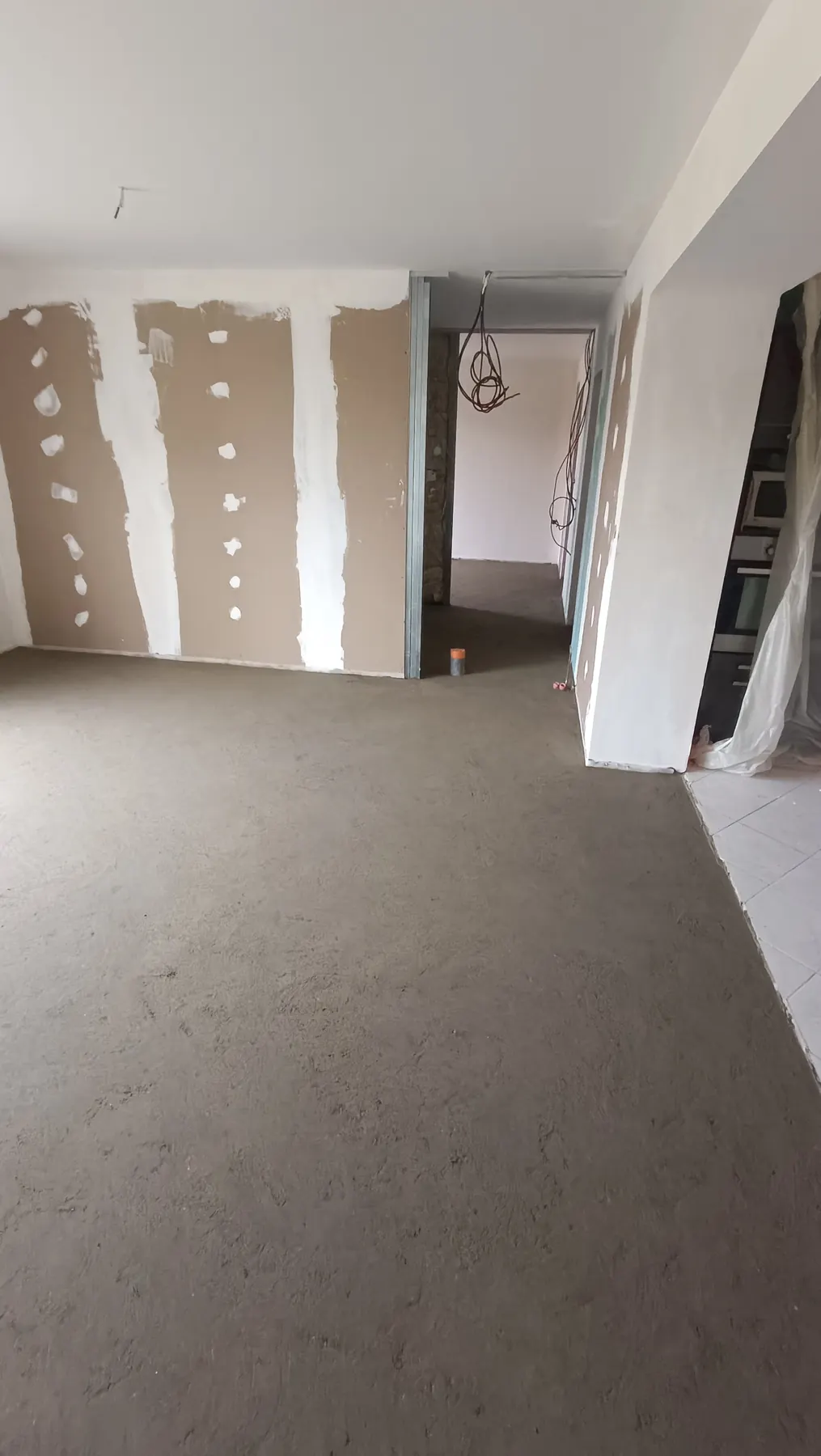
Per m², the two ranges overlap: a fibre-reinforced compound on a difficult substrate can cost as much as a simple screed. But they do not solve the same problem, and price should not be what decides.
Prices per m² in 2026
The table separates supplied and laid prices, the most common way these jobs are quoted, from labour-only prices where price guides publish them.
| Job | Indicative range | What the price covers |
|---|---|---|
| Levelling compound, self-levelling to fibre-reinforced | €15 to €35 per m² | Supplied and laid, about 3 to 5 mm, on a standard substrate |
| Levelling compound, labour only | €10 to €20 per m² | Application only, product supplied by the client |
| Levelling over old tiles, a timber floor or in a thicker layer | up to about €40 per m² | Specific primer, fibre-reinforced product or greater thickness |
| Traditional sand and cement screed | €20 to €35 per m² | Supplied and laid, around 5 cm thick |
| Flowing anhydrite screed | €25 to €50 per m² | Supplied and poured |
| Flowing cement screed | €20 to €45 per m² | Supplied and poured |
| Flowing screed, labour only | €10 to €30 per m² | Pouring only, material excluded |
| Floating screed on insulation or thick build-up | €35 to €55 per m² | Insulated or thicker work |
| Removing old floor tiles, if needed | €15 to €30 per m² | Labour only, rubble removal often extra |
Materials make up a large share of the cost of a screed or levelling layer, which is why prices are usually quoted with supply included. For a traditional screed, price guides do not publish a reliable labour-only figure, so we do not give one.
Traditional, anhydrite or flowing cement screed
A traditional sand and cement screed is ruled off with a straightedge and then floated. Versatile, it suits dry and wet rooms alike and needs no pumping equipment. In return, it takes longer to lay and to dry.
A flowing screed is pumped into place and levels itself almost unaided. Anhydrite, based on calcium sulphate, gives a very flat surface and fully surrounds underfloor heating pipes; it must be sanded before laying and protected by waterproofing in areas exposed to water, such as a shower. Flowing cement screed, less sensitive to moisture, can be used in a wider range of rooms.
The cost of the pumping equipment is spread over the area poured: a flowing screed makes most sense on a large area, while a traditional screed is often the more sensible choice for a small room or a local repair.
Screed and levelling over underfloor heating
A wet underfloor heating system is embedded in a screed with enough thickness above the pipes. Flowing screeds are often preferred because they surround the pipes without air pockets; a traditional cement screed remains a proven option. Either way, a gradual first heating cycle, following the manufacturer’s procedure, comes before any floor covering is laid.
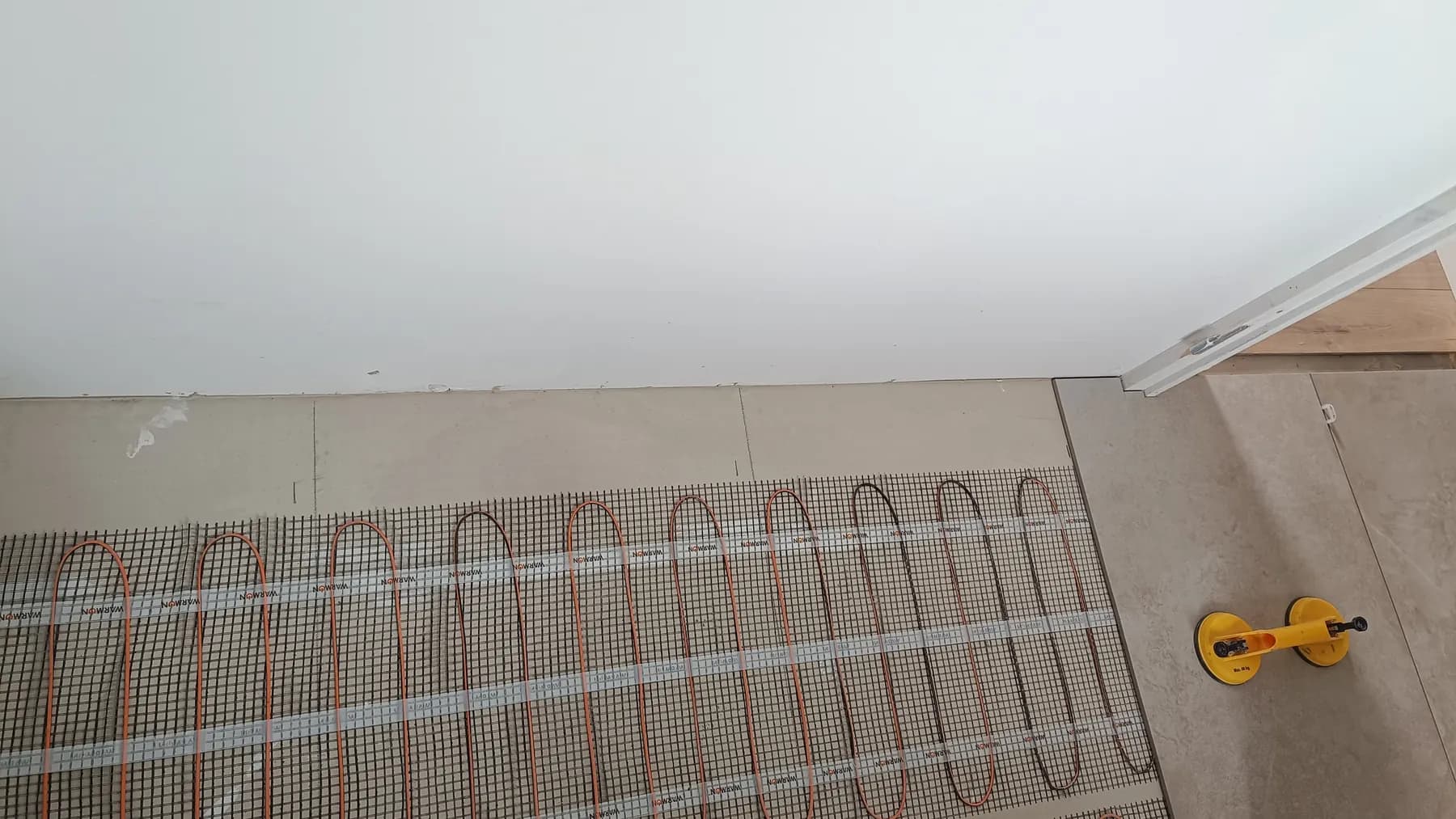
Some electric systems with thin cables are embedded in a levelling compound or another thin layer instead, as their instructions specify. In every case, the heating system itself is not part of the ranges above: only the screed or levelling layer that covers it is counted. Allow time in the schedule for the first heating cycle too.
Drying and residual moisture before tiles or parquet
Drying does not appear on the quote, but it weighs on the schedule. A traditional screed dries slowly: a rule of thumb suggests about one week per centimetre for the first few centimetres, and longer beyond that, depending on temperature and ventilation. An anhydrite screed follows its manufacturer’s timings and must be sanded to remove its laitance.
Before laying, we measure the residual moisture, for example with a carbide tester, and compare it with the limit accepted for the planned covering. Parquet and anhydrite screeds are the most demanding: our guide to parquet laying costs explains what this preparation means for wood. Laying too early to save a week risks tiles debonding or parquet cupping.
A levelling compound dries much faster, from a few hours to a few days depending on the product, its thickness and the planned covering: one of its advantages when the height to make up allows it.
What changes the price
Two floors of the same size can call for very different budgets. The differences mainly come down to these points:
- Height to make up. A few millimetres can be handled with a levelling compound, several centimetres call for a screed. The average thickness sets the amount of material: it is the first price factor.
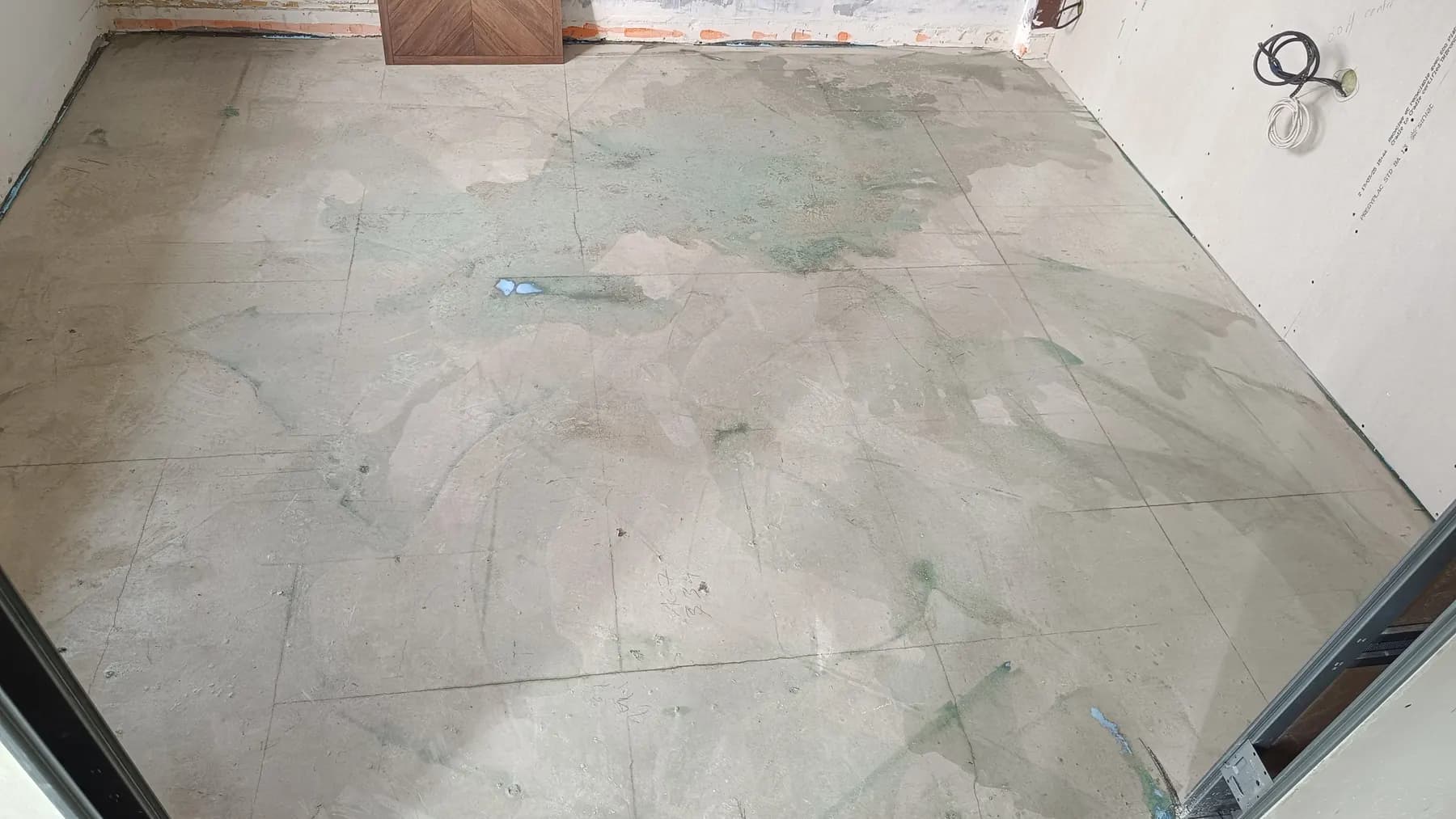
- Condition of the substrate. A dusty, cracked or crumbly slab must be scraped, ground and filled before any levelling compound. This preparation is added to the price of the product.
- Type of substrate. Old tiles need a specific bonding primer, a timber floor a fibre-reinforced compound and a stiffness check: the price then rises to about €40 per m². Our article on tiling over existing tiles covers this case in detail.
- Area and access. Small areas cost more per m², and a flowing screed means running a pump hose all the way to the room, which gets harder on upper floors.
- Removal. Taking up old floor tiles adds €15 to €30 per m² in labour, with rubble removal often extra.
- Final covering. Large-format tiles or glued parquet require tighter flatness than standard tiles: a floor that is acceptable for one may need full levelling for the other.
Paris, Île-de-France and Évreux
According to price guides, labour costs 20 to 30% more in Paris and Île-de-France than in the provinces. On a screed or levelling job, the gap mainly affects the labour, since materials vary little from one region to another; building constraints (upper floors, lifts, running a pump hose, co-ownership working hours) weigh more heavily in Paris.
Évreux and the Eure fall within the provincial price bracket. We prepare floors in the Eure as well as in Paris and Île-de-France, usually before laying the covering ourselves: the screed and levelling work is then planned around the tiles or parquet that will follow.
Reading a screed or levelling quote
A precise quote states, for each room:
- the area and the planned average thickness, or the height to make up;
- the product: traditional, anhydrite or flowing cement screed, self-levelling or fibre-reinforced compound;
- the preparation: removal, grinding, filling, primer;
- the accessories: perimeter strips, membrane, insulation, movement joints;
- sanding off the laitance on an anhydrite screed;
- whether laying the floor covering is included or priced separately.
Common exclusions: rubble removal, the underfloor heating, treatment of structural cracks, repairs to a structural slab. On VAT, renovation work on homes completed more than two years ago is charged at 10%, against 20% for new builds; many guides do not say whether their prices include VAT. Our article on the information to prepare for a tiling quote helps you describe your floor, and our guide to tiling costs per m² completes the budget for the covering.
Frequently asked questions
Does the price of a levelling compound include the primer?
It should, because a levelling compound is not applied without the primer its manufacturer specifies: the primer provides the bond and regulates the porosity of the substrate. The average ranges assume a standard substrate. On old tiles, painted floors or timber, the primer is more technical and the price moves towards the top of the range. Check that the quote names the primer planned.
Is a flowing screed more expensive than a traditional screed?
Per m², the ranges overlap: €20 to €35 per m² for a traditional screed, €25 to €50 per m² in anhydrite and €20 to €45 per m² in flowing cement, supplied and laid. A flowing screed is poured quickly over a large area, but its pumping equipment weighs more on a small room. The choice is made first on technical grounds: underfloor heating, thickness, wet room, timing.
Does the screed have to be redone when the tiles are replaced?
Not necessarily. After removal, a sound screed can often be kept: the adhesive residue is taken off, we check that it does not sound hollow and is still flat, then a levelling compound is enough if the surface has suffered. A cracked, detached or badly damaged screed, on the other hand, is repaired locally or in full. That is why a quote sometimes includes this item subject to inspection after removal.
Does a floating parquet floor need a screed?
Not necessarily. A floating parquet floor can go on a slab, an existing screed or old tiles, provided the substrate is flat, sound and dry. The underlay absorbs small irregularities, not marked hollows or bumps: a levelling compound corrects those. A screed only becomes necessary to make up several centimetres of level or to incorporate insulation or underfloor heating.
Can I apply the levelling compound myself to cut the bill?
You can, but the tradesperson who then lays the tiles or parquet has to check that substrate before working on it. If it is hollow, cracked, dusty or out of flat, it will need redoing, which costs more than having it levelled in the first place. A good result takes the right primer, carefully measured mixing water, quick pouring and thorough rolling to release air: the saving is only real if all of that is mastered.