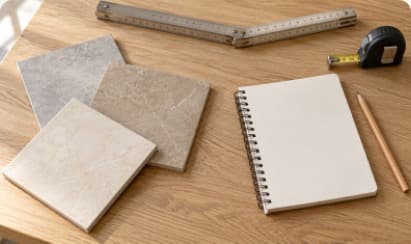
Planning your project
Tiling quote: what information should you prepare?
Surface area, condition of the substrate, preferred tile size: gather the details that help you present your project to a tiler.
Parquet
Nailed, glued or floating, in straight, herringbone or chevron layouts: we lay your parquet on a checked substrate, with the expansion gaps and finishes that wood requires.
At a glance
Laying parquet means installing wooden boards on a prepared substrate: nailed to battens or an existing timber floor, fully glued to a screed or slab, or joined together as a floating floor on an underlay. Because wood is a living material, success depends on moisture levels in the substrate and the room as much as on careful laying.
We help you choose the parquet, the finish and the installation method according to the room, the substrate and the heating, in Paris, Évreux and the surrounding areas. When the substrate needs it, we prepare it too: screed, levelling compound or flatness correction.
Materials
The type of parquet determines which installation methods are possible, how it behaves over underfloor heating and how many times it can be renovated.
Hardwood through its whole thickness: it can be sanded and renovated several times over the decades. It is nailed or glued and reacts more to changes in humidity, so the substrate and the indoor climate need to be well controlled.
A hardwood wear layer a few millimetres thick, bonded to a core of plywood, softwood or fibreboard. More stable than solid wood, it can be floated or glued, sometimes nailed, and sanded once or more depending on the thickness of that layer.
Often mistaken for parquet, it is not parquet: it is a printed pattern under a protective layer on a fibreboard panel. Affordable and scratch-resistant, it cannot be sanded and is replaced once worn.
Oak leads the way for its hardness and stability. Ash offers a light, pronounced grain, walnut a dark, warm tone. Beech and maple, more sensitive to moisture, need extra care. The grade (the number of knots and the amount of sapwood) also changes the look.
Lacquered or varnished: a protective film that is easy to clean and renewed by sanding. Oiled: a natural matt look that can be repaired locally but needs more regular care. Unfinished: sanded and finished on site after laying, in the colour and protection you choose.
With a floating floor, the underlay reduces impact noise and absorbs small irregularities. On a mineral substrate, a vapour barrier membrane protects the wood from moisture rising from the floor. Over underfloor heating, the underlay must have low thermal resistance.
Our method
Wood reacts to its surroundings: a good installation starts with measurements, not with the first board.
We check the flatness of the substrate, its moisture (with a carbide tester on a screed), the humidity of the room, any underfloor heating and the height available under doors.
Nailed to battens or an existing timber floor, fully glued to a dry substrate, or floating on an underlay: we choose the method that suits the parquet, the substrate and the way the room is used.
Levelling compound or flatness correction where needed, primer to suit the adhesive, a vapour barrier for floating floors on mineral substrates, and undercutting door casings so the boards slide beneath them.
Once wet trades are finished (plaster, paint, a dry screed), the packs stay in the room for the time set by the manufacturer, usually 48 hours or more, so the wood can reach equilibrium.
We mark out the axes, set the direction of the boards according to the light and the shape of the room, then lay them with staggered end joints, or work from the central axis for herringbone and chevron.
A gap is left around the edges and around pipes, hidden by skirting, pipe collars and threshold strips. Skirting is fixed to the wall, never to the parquet, so the floor can move freely.
Cleaning, a final check with you, the waiting time before moving furniture back depending on the adhesive, and care advice suited to the finish and to keeping indoor humidity moderate.
Tell us about the room, the substrate and the parquet you have in mind: we will come and check the substrate, advise you on the installation method and provide a free quote.
Tools
Measuring tools for the substrate, precise cutting tools for the wood.
Good practice
Each installation method has its French reference standard, supplemented by the parquet manufacturer’s instructions.
Your questions
Solid parquet has the longest lifespan because it can be sanded several times, but it needs a very stable substrate and indoor climate. Engineered parquet, more stable thanks to its layered structure, suits more situations: floating installation, renovations with little height available, underfloor heating. Once laid, the two are often hard to tell apart by eye.
Yes, in most cases. For a floating floor, the tiles must be flat and stable, covered with a suitable underlay. For glued installation, they are cleaned, degreased and prepared as the adhesive manufacturer requires, and deep grout lines are filled with levelling compound if needed. The extra height under doors and at transitions with other rooms also has to be taken into account.
In a kitchen, yes, with a protective finish and careful upkeep near the sink. In a bathroom, it is possible with a product and species designed for it, good ventilation and neat flexible sealant around the edges, but never in the shower area. Where water splashes are frequent, wood-effect porcelain tiles remain the worry-free option.
Wood constantly exchanges moisture with the air. In winter, heating dries the indoor air and the boards shrink slightly: fine gaps appear, which often close again in the warmer months. This is normal behaviour for wood, and it can be limited by keeping indoor humidity moderate, with a humidifier if needed. Engineered parquet is less prone to it.
Both create a zigzag pattern. In herringbone (bâtons rompus), the boards are cut square and interlock in a staggered way, the end of one against the side of the next. In chevron (point de Hongrie), the ends are cut at an angle, often 45 degrees, and meet in a point along a continuous line. Both need precise setting out from the room’s axis and take longer than a straight layout.
Yes, if the manufacturer declares it suitable. Engineered parquet is generally preferred, glued or floating on an underlay with low thermal resistance, and sensitive species such as beech or maple are best avoided. The screed must have completed its first heating cycle and be dry, the heating is turned down during laying, and the surface temperature stays capped. A cooling floor system needs extra precautions.
It depends on the thickness of wood above the tongue. Solid parquet can be sanded several times over the years. Engineered parquet can be sanded according to the thickness of its wear layer: once or more with a thick layer, sometimes not at all with a very thin one. Oiled parquet can also be refreshed without sanding, simply by re-oiling.
Our other services
 AI-edited image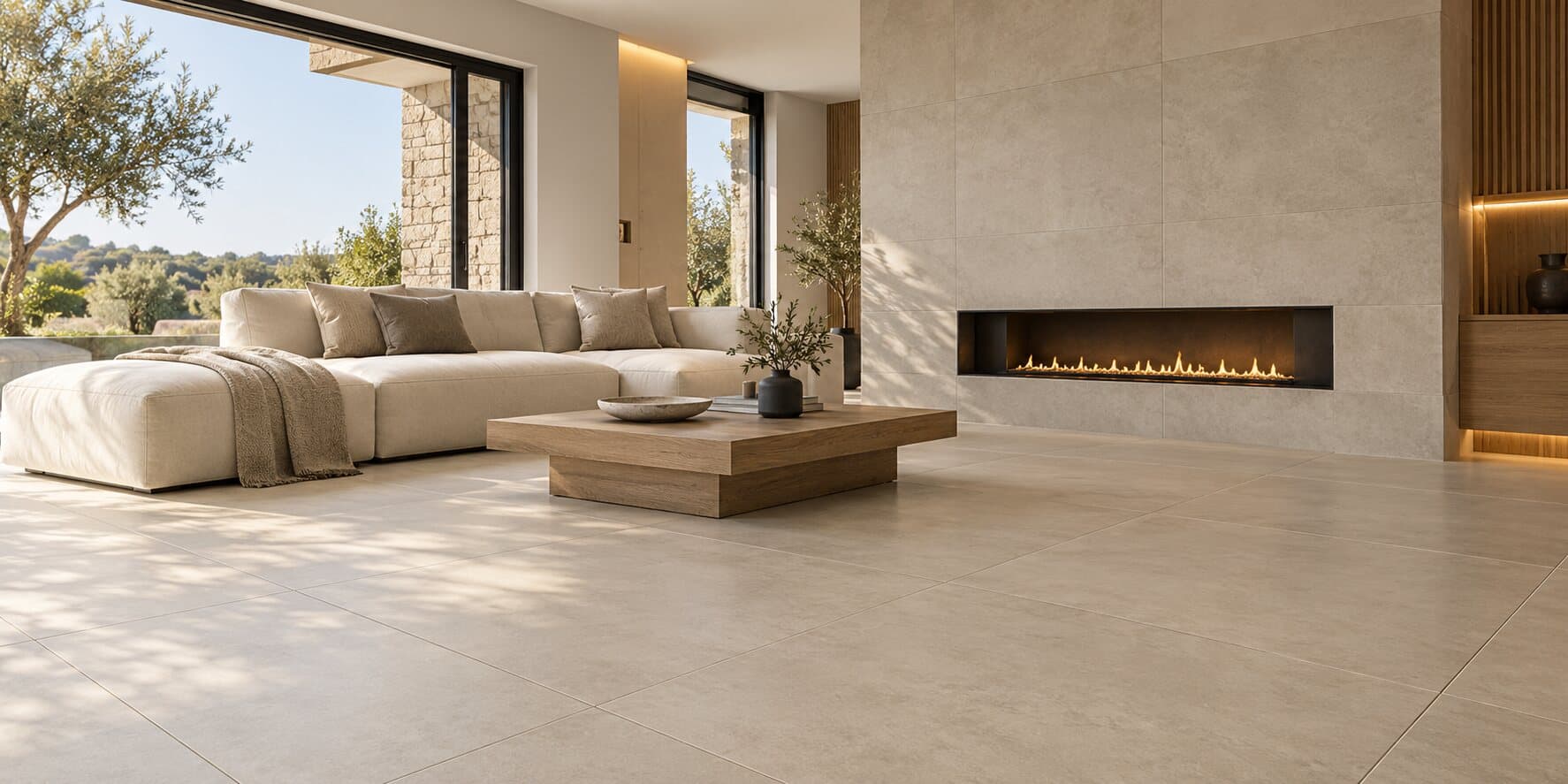
Planning your project
Surface area, condition of the substrate, preferred tile size: gather the details that help you present your project to a tiler.
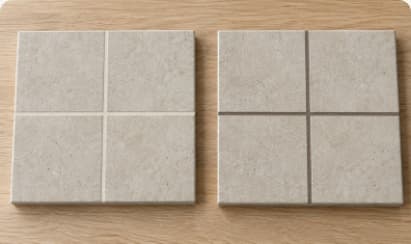
Inspiration
Natural shades, textures and pairings with wood: find inspiration to create a simple, welcoming space.