Planning your project
How to choose a good tiler: questions, insurance and red flags
To choose a good tiler, ask to see real jobs, have them visit before they price the work, compare written and detailed quotes, then check their registration and insurance certificates. A good tradesperson explains how they prepare the substrate and protect wet areas, without pushing you to sign.
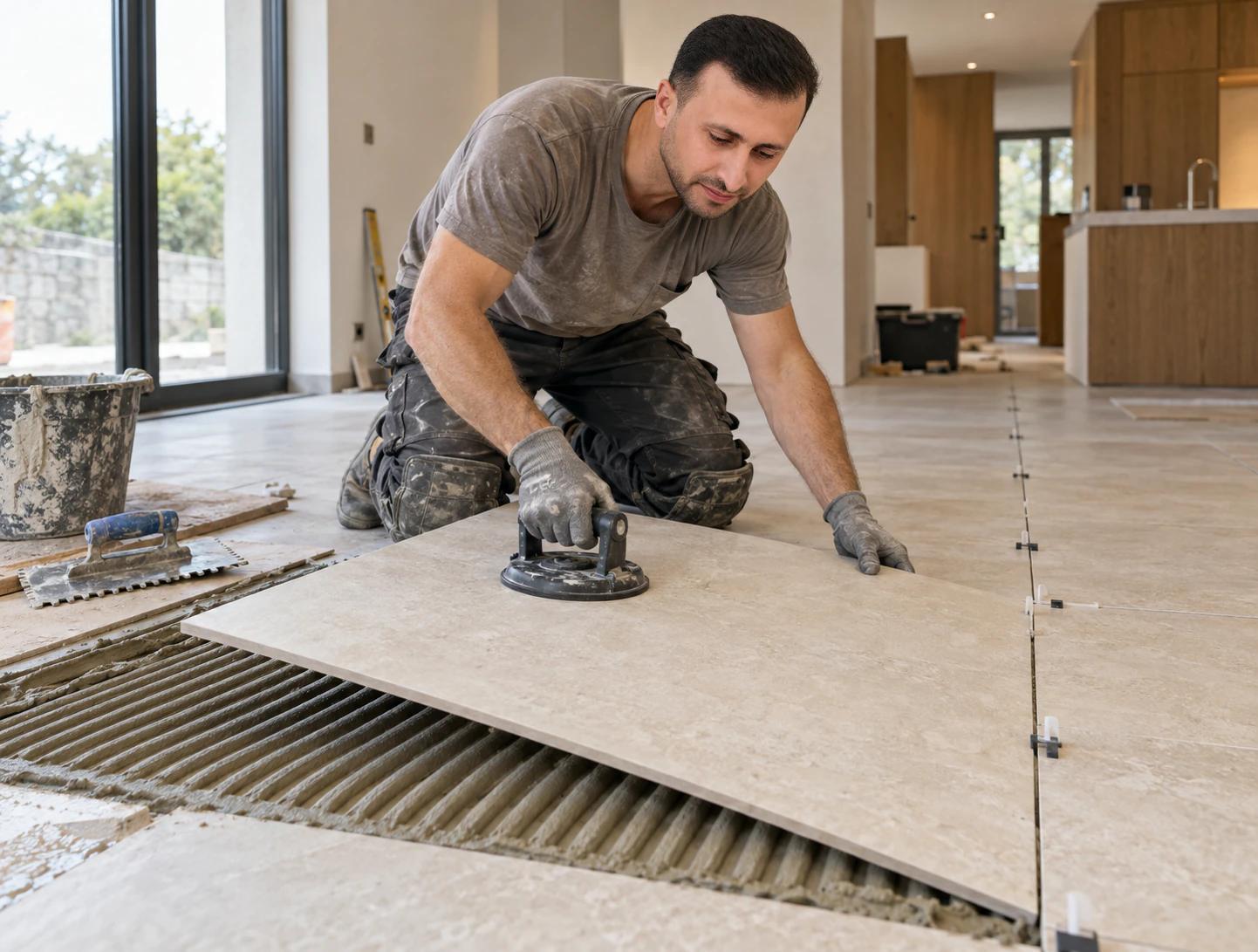
Badly laid tiles cannot be put right after the event: tiles that sound hollow, cracking grout, a shower leaking behind the walls. Most of these faults start before the tiles go down, with a poorly prepared substrate or neglected waterproofing, and a client cannot see them once the job is finished. Hence the importance of choosing the right tradesperson.
We are tilers ourselves, and this advice applies whoever you end up hiring. These are the questions we would like every client to ask before signing.
The questions to ask a tiler
A first conversation, on the phone or on site, already tells you a lot. Ask about:
- their experience with your type of work: a walk-in shower, large formats or natural stone call for different skills from an ordinary floor;
- photos of real jobs, ideally in progress (prepared substrate, waterproofing, layout), not just pictures of finished rooms;
- references: former clients willing to talk, or a recent job you could go and see;
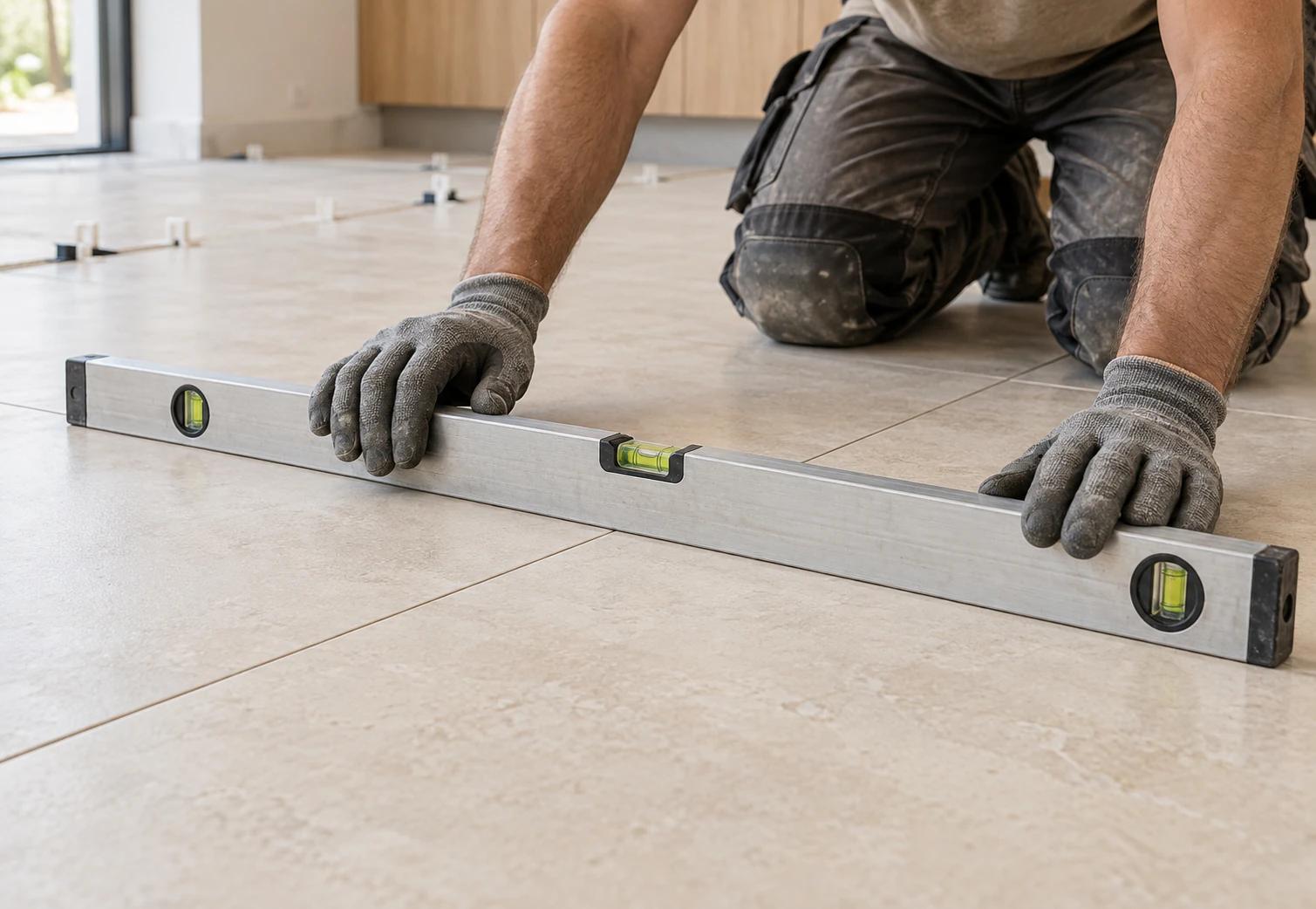
- how they check the substrate: flatness, cohesion, moisture, tiles that sound hollow when tapped with a mallet;
- which rules they follow: in France, bonded tiling follows the NF DTU 52.2 standard, explained in our article on tiling rules and standards;
- how they protect a shower: which waterproofing system, the SPEC in a home, and how they deal with corners and the drain;
- who will do the work: themselves, their employees or a subcontractor;
- who supplies the tiles, who removes the rubble, when the job starts and how long it lasts.
A good tiler answers precisely and asks you questions in return: how the room is used, whether there is underfloor heating, how much clearance there is under the doors.
The visit before the quote: an essential step
A few photos are enough for a first estimate, rarely for a reliable quote. On site, the tiler measures the surfaces, sounds out the old covering, checks the walls are plumb and the floor levels, locates pipes and thresholds, and looks at access: stairs, lift, parking, which matter a great deal in a Paris flat.
Without a visit, the tiler either builds in a margin for the unexpected or adds extras once the work has started. The visit also lets you judge their method: someone who takes the time to check the substrate will take it during laying.
What a reliable tiler puts in writing
The quote is your main tool for comparison. Written, dated and detailed, it should show:
- the company details: name, address, SIRET number, and the insurance held with the insurer’s contact details;
- the preparation: removal, rubble disposal, levelling, primer, wall repairs;
- the waterproofing of wet areas, item by item;
- the laying, with areas in square metres, the tile size and the pattern (straight, offset, herringbone);
- grout and finishing: skirting, trims, silicone joints;
- supply shown separately from labour, with the tile references if the tiler supplies them;
- the amounts before tax, the VAT rate and the total including tax, the validity period, the deposit and payment stages, and the planned timing.
To prepare your request, see our article on the information to give for a quote, and to put the amounts in context, our guide to tiling costs per square metre. If you sign the quote at home after the visit, you normally have a 14-day cooling-off period.
Ten-year insurance and public liability: what to check
The garantie décennale, the French ten-year builder’s liability, covers for ten years after handover any damage that undermines the soundness of the work or makes it unfit for its purpose: a shower where water gets through the substrate, for example. Businesses whose work falls under it must be insured to cover it. Professional public liability insurance covers damage caused to you or to third parties during the job, such as a leak into the flat below.
Ask for the certificates before signing, and check:
- that the name and SIRET number match those on the quote;
- that the insured activities match the work: tiling, plus plumbing or waterproofing if they are part of the job;
- that the certificate is valid on the date the work starts, since the policy in force at that moment is the one that applies;
- that the geographical cover includes your town.
French law also requires tradespeople subject to compulsory insurance to state on their quotes and invoices the insurance held, the insurer’s contact details and the geographical cover. At the end of the job, formal handover, ideally with a signed report, starts the guarantees running, including the one-year guarantee of completion (garantie de parfait achèvement).
Checking the business: SIRET and the official register
The SIRET number has 14 digits and identifies the business establishment. Enter it, or the company name, on the Annuaire des Entreprises, the official government website (annuaire-entreprises.data.gouv.fr). It shows whether the business is active, when it was set up, its address, its registered activity and who runs it.
A closed business, an activity unrelated to building work or an address that differs from the quote all call for an explanation. A recently created business is not a bad sign in itself: an experienced tiler may only recently have set up on their own. Finally, the RGE label is not relevant to tiling: it covers energy-efficiency renovation work.
Warning signs
- no visit, or a price given over the phone for a whole bathroom;
- no written quote, or a one-line lump sum with no areas or detail;
- a large deposit requested in cash before anything is ordered, even though cash payments to a business are capped by law at €1,000;
- pressure: a price valid only today, a start date tomorrow;
- no SIRET number, or a refusal to provide insurance certificates;
- a price far below the others with no explanation, often because preparation or waterproofing has disappeared from the quote;
- an offer to work without an invoice.
None of these signs proves bad intentions on its own, but several together should make you think twice before signing.
Online reviews, comparing quotes and platforms
Google reviews are useful if you actually read them: content, dates, photos and how the tradesperson responds to criticism. A few detailed reviews spread over several years say more than a run of five-star ratings with no comment, all posted in the same week.
To compare two or three quotes, first make sure they describe the same work, line by line. A price gap almost always has a reason: preparation included or not, waterproofing, supply, finishing. Do not hesitate to ask each tiler why they have included a particular item.
Matching platforms let you get several contacts quickly. In that case, check who will actually do the work and who you will call if there is a problem. A local tradesperson knows the buildings of the area, old houses and apartment blocks alike, and remains reachable after the job.
How we work at Beyazgul Carrelage
Ozcan Beyazgul is a master tiler with 25 years of experience. He worked in Turkey, Russia, Kazakhstan and Cyprus before settling in France five years ago. Your tiler based in Louviers works in Évreux, throughout the Eure, in Paris and across Île-de-France.
Our method follows the steps described above: a first conversation to understand the project, a visit to check the substrate, then a free, written and detailed quote that separates supply from labour. We explain how we prepare the substrate, protect wet areas and lay the tiles, following the professional rules for floor and wall tiling. Photos of our real jobs are on our projects page.
Ask us the same questions as the other tilers you consult: it is the best way to compare.
Frequently asked questions
How many quotes should I get for tiling work?
Two or three quotes are usually enough to gauge prices and compare methods. Beyond that, comparison becomes difficult, and serious tradespeople, who travel for each visit, are less available. What matters is that each quote describes the same work, with the areas, preparation and waterproofing, so that the price difference means something.
How can I check that a tiler is properly insured?
Ask for the insurance certificate before signing and read it: the name and SIRET number must match the quote, the insured activities must match the work, the validity period must cover the start date and the geographical cover must include your town. If in doubt, you can contact the insurer named on the certificate to confirm that the policy is current.
Should I always pick the cheapest quote?
Not necessarily. A low price may reflect efficient organisation, but it often hides substrate preparation, waterproofing or finishing missing from the quote. Compare item by item and ask what is included and what is not. On a floor or a shower, money saved on preparation is almost always paid for later.
Can a tiler subcontract part of the job?
Yes, subcontracting is allowed, but the company that signs the quote remains responsible to you for the work. Ask from the outset who will come to your home and whether any part, the plumbing for example, will be handed to another business. That business must then be insured for its activity, and you should know who to contact if there is a problem.